Aligning Biomedical Texts and Knowledge Graphs: A Systematic Comparison of Lightweight Alignment Strategies
- Conference/Journal: KG-NeSy @ ISWC2026
- Year: 2026
- Full paper URL: https://arxiv.org/abs/2608.23214
Abstract
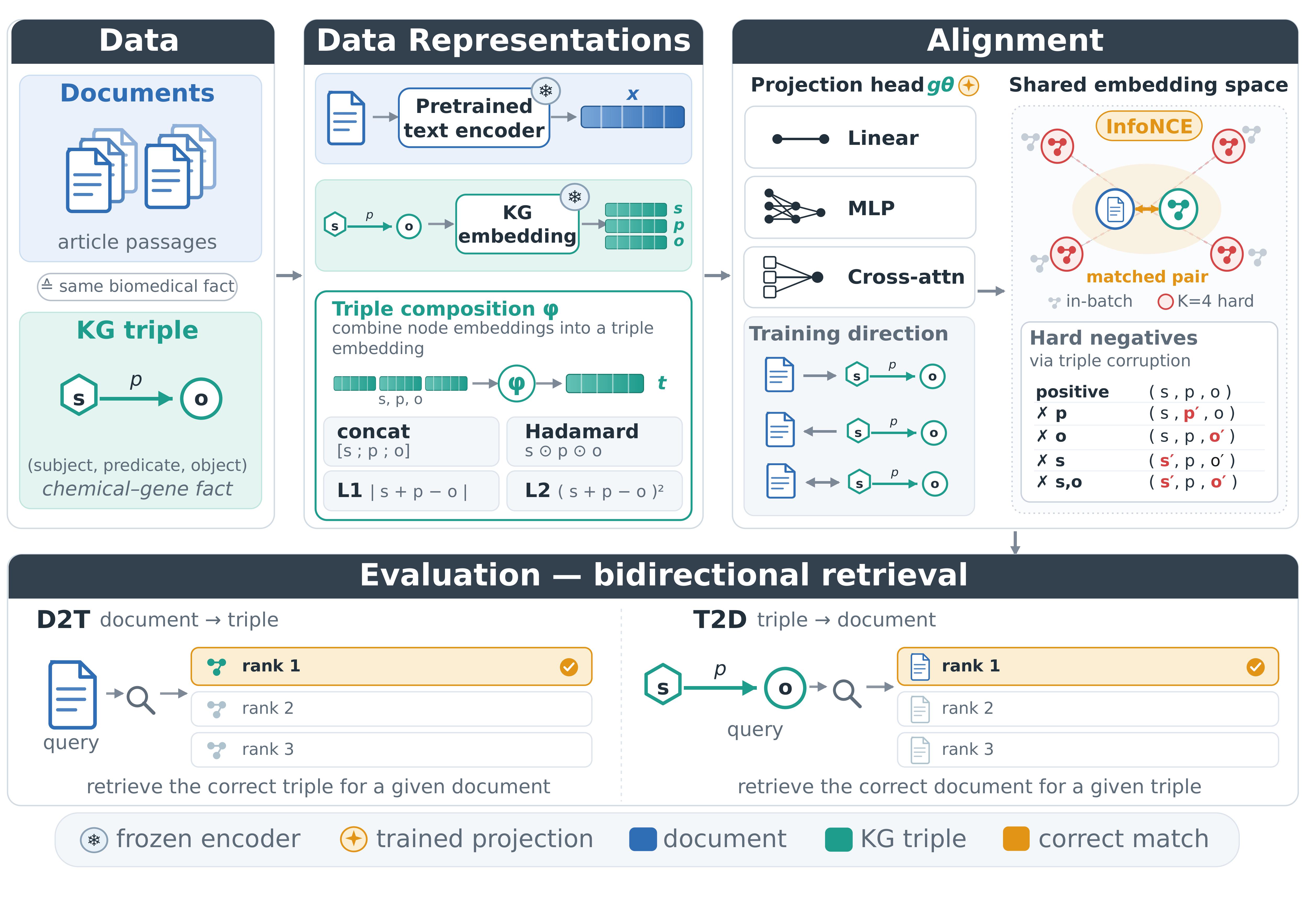
Biomedical knowledge exists in two complementary but distinct forms: unstructured scientific literature and structured knowledge graphs (KGs). Aligning them is essential for knowledge grounding, evidence retrieval, and KG completion, yet existing methods do not explicitly align free-text evidence with KG triples. We present a unified framework for systematically studying design choices for aligning biomedical text and KGs. With a text encoder and a KG embedding model both frozen, we learn only a lightweight projection between their spaces via a contrastive objective. This enables a fair comparison across six design dimensions: text encoder, KG embedding model, projection head, triple composition, training direction, and hard-negatives sampling. We construct CTD-Align, a corpus of over 22K one-to-one triple-document pairs linking chemical-gene interactions from the Comparative Toxicogenomics Database to supporting PubMed passages. We evaluate alignment on it in two retrieval settings: document-to-triple and triple-to-document. We find that the triple composition and the training direction (i.e., shared retrieval space) have the greatest impact, whereas the text encoder and hard-negatives sampling matter little. Overall, simple choices win: projecting text into the KG space with a linear head over concatenated subject, predicate, and object embeddings performs best. These findings establish lightweight contrastive alignment as an effective, practical foundation for bridging biomedical text and KGs.